Change Can't Come Soon Enough
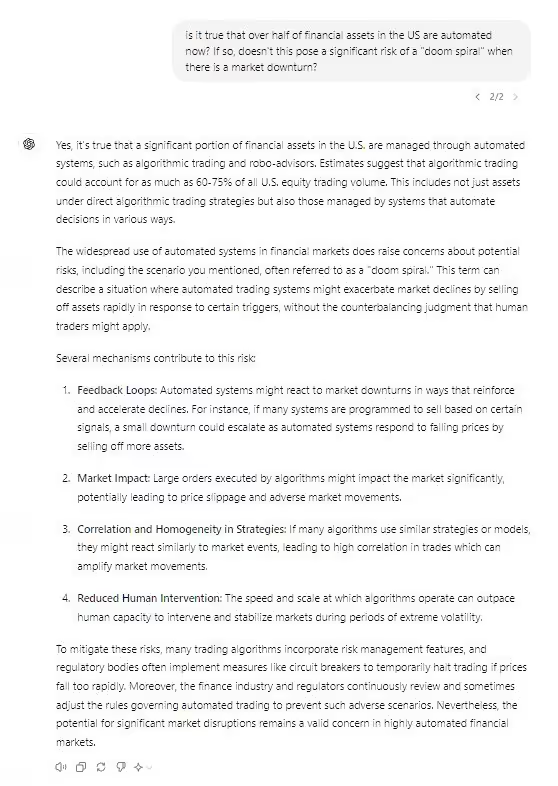
People seem to listen to GPT these days so this is basically it saying the same thing I've been saying for a while - during the last decade or so, automated trading crossed the threshold of 50% and well into where the vast majority of financial assets in the US are done by algorithms and computers now.
These algorithms are designed to sell when the price dips, and buy on the "rebound" in the short-term. This works fine when the market is always going up, but these systems have never been tested during market downturns or recessions, which is what is getting a lot of analysts anxious about what's to come over the next few years. We are going to be entering into an unknown territory in finance very soon - probably the biggest liquidity event of our generation, honestly. And it will all be done by robots, for the most part.
We've already got a small tastes of it with "meme stocks" like GME and AMC, where they manipulated the trading algorithms in a way was favorable to a few - but it drops as fast as it grows because that's just the way it was designed. But what if the "foundation" of the stock market always going up were to be suddenly be gone? It will put immense selling pressure on every asset out there - again, because that's what it was designed to do.
Sure, they could "pull the plug" on these algorithms manually, as they've been trying to do in recent years to stop meme-stocks from growing too big. But in a market downturn, people will be looking at their portfolios that are dipping significantly, and start to question whether or not it's worth holding onto themselves. Both humans and robots aren't too keen on "numbers going down", after all.
So, in light of all of this, there is crypto, which is the most obvious "alternative asset" in the space right now, next to precious metals (seen as an eccentric niche) and commodities (seen as boring and too traditional) - in the midst where there will be a lot of cash floating around, not knowing where to go. And for crypto to do very well, all it needs is about ~1% of that money to flow into the industry, which doesn't seem like too unreasonable of an assumption, really.
For over two decades now, the US economy has been in an "inflationary" state, where the stock market seems to go up and up, no matter what happens or how bad things seem to get. We have a whole generation whom that's all they know. When I talk to people from Japan, they know what a recession "feels" like, but Americans often don't - it's just been way too long and the very idea of it seems to scare off most people from even beginning to think of it.
The good news? Well, if you look at how Japan has been doing recently, the quality of life there is actually very high, and on average, most people there are doing better than most people here in the US. That's because when assets go down, so do costs - for the vast majority of people (80% of whom don't even own stocks), this would probably be an improvement over all. You might make less money from jobs, but in exchange, the costs of goods like food, shelter, education, health - they will also all go down, too.
In the end, economics always balances themselves out and reaches equilibrium, both in its ups and downs. There will always be winners and losers, opportunities gained and opportunities lost. What's difficult is knowing when things are changing, and how to adapt to said changes when they come. And I think it's fair to say that a "big one" is coming to us very soon - probably after November, where the political pressures to pretend like "there's nothing to see here" all go away.
Unless people think the path we're on now is actually sustainable? I don't know a single person who thinks that these days - even those I vehemently disagree with. Change is in the air, and it is coming - and the anticipation is driving a lot of people crazy - sometimes literally. It can't come soon enough, honestly. 🙏